
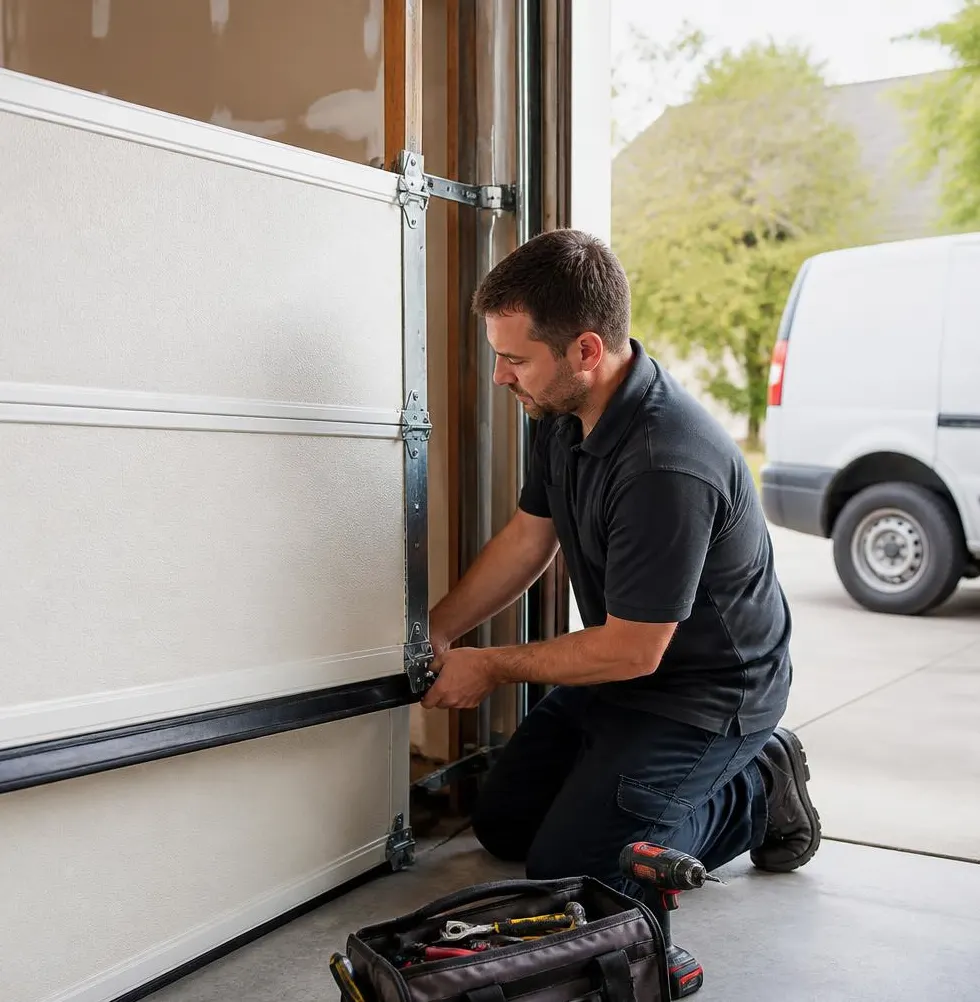
The Moment You Notice It
You're in the garage grabbing something off the shelf when a gust hits and the door flexes. Not a lot, just an inch or two of give in the middle panel, a shudder that runs up the track, maybe a rattle from the top section where the weatherstripping has pulled away. It stops as fast as it started. You go back inside and mostly forget about it, until the next front rolls through and it happens again, a little worse this time.
That flex is worth paying attention to. Fall in this part of Illinois brings a string of strong cold fronts pushing through ahead of winter, and the wind gusts that come with them can hit a garage door harder than almost any other part of the house.
Why the Garage Door Is the Weakest Wall
Think about the surface area. A typical two-car garage door is one of the largest openings in the entire structure, a single unsupported panel roughly 16 feet wide. Every other wall in the house has studs, sheathing, and siding working together. The garage door has thin steel or wood panels, a set of rollers, and two vertical tracks holding the whole thing against wind pressure.
When wind hits the front of a house, pressure builds against that big flat surface. If the door isn't braced to handle it, it can bow, pop off its rollers, or in a bad enough gust, blow in entirely. Once that happens, wind gets inside the garage and pushes up against the roof from underneath, which is how a single weak garage door can turn into roof and structural damage for the whole house. It's not the siding or the windows that engineers worry about most in high-wind events. It's the garage door.
Signs Your Door Won't Hold Up
- Visible bowing in the center of the panels during wind, even if it springs back
- Rattling or banging along the track, which usually means loose roller brackets or worn rollers
- Gaps of daylight around the edges or along the bottom, meaning the seal and possibly the fit have degraded
- Track brackets with play in them when you push on the door by hand
- An opener that strains or hesitates even in calm weather, a sign the door isn't moving smoothly in the track already
- Rust at the hinges or rollers, common here thanks to humid summers followed by salt-heavy winters that get tracked in from the driveway
Any one of these on its own might just be routine wear. A couple of them together, especially combined with visible flex during wind, means the door is already struggling with normal conditions and won't do well in a genuine storm.
Getting the Door Ready for Wind Season
Check and tighten the track hardware
Track brackets loosen over time from vibration and temperature swings. Walk the full length of both tracks and check that brackets are snug against the framing, roughly every two feet. A track that's pulling away from the wall even slightly gives the door room to rack sideways under pressure.
Inspect rollers and hinges
Worn or rusted rollers bind in the track, which makes the whole door work harder and shortens the life of the opener and springs. Nylon rollers typically last longer than steel in this climate since they don't corrode from road salt residue, and they run quieter too. If yours are original to an older door, replacement is inexpensive compared to the cost of a jammed door during a storm.
Add or check reinforcement
Many doors built in the last couple of decades come with a horizontal reinforcement strut, often called a u-bar, mounted across the top panel. If your door doesn't have one, or if it's only on the top section, adding struts to the middle panels significantly increases the door's resistance to wind pressure. This is one of the more cost-effective upgrades available, generally in the low hundreds of dollars range for materials and installation, far less than repairing storm damage.
Replace worn weatherstripping
Weatherstripping does more than block drafts. A tight seal keeps wind-driven rain from forcing its way around the edges and also keeps the door seated properly in the track. If the strip along the bottom or sides is cracked, flattened, or pulling loose, swap it out before storm season rather than after.
Test the auto-reverse and manual release
This matters for safety any time of year, but it's worth confirming before storm season specifically. If the power goes out mid-storm, you want to know the manual release cord works smoothly so you can operate the door by hand if needed.
Timing It Right
Fall here swings fast, warm humid days one week and a sharp cold front with gusty wind the next, then eventually the freeze-thaw cycles of winter that put extra stress on hardware and seals. Getting the door inspected and reinforced now, before the ground freezes and before the heaviest wind events of late fall and winter, is more effective than trying to fix a problem mid-storm.
When to Call Alton Garage Door Co
If you've noticed bowing, rattling, or gaps, or if it's just been a while since anyone looked at the hardware, that's the time to call. We handle Garage Door Maintenance visits that cover track alignment, roller and hinge condition, and weatherstripping, catching the small issues before a wind event turns them into big ones. If your door needs reinforcement struts, hardware upgrades, or is old enough that a full replacement with a sturdier, better-sealed model makes more sense, our Garage Door Installation team can walk you through options built for this area's weather swings.
Don't wait for the next front to find out how your door holds up. Call Alton Garage Door Co today to get your garage door storm-ready before winter sets in across Alton, IL and the Metro East.